

How Technology Expands One Person's Capacity
What to Automate When You Are the Only Check



Technology expands one person’s capacity when it removes the labor of a step and leaves the signal from that step intact. When it removes both, output can rise while judgment gets weaker. The cost often appears later as rework, missed problems, or decisions that have to be revisited after the consequences become visible.
The question worth asking is simple: which steps can you stop doing and still notice when you were wrong?
The brief
If you are building alone, you already run a stack that would have taken several people fifteen years ago. Drafting, research, design, deployment, support, invoicing, analysis. Much of it works well enough to keep. The harder part is knowing which output you can trust.
The usual concern is quality. Tools make mistakes, so you check the output. That part is manageable. The deeper problem is that doing the work by hand was often how you learned what a mistake looks like in the first place. Once the work disappears, some of that exposure disappears with it.
Capacity comes in two forms. Execution capacity is how much you can produce. Judgment capacity is how many correct decisions you can make about what to produce, what to keep, what to reject, and what needs more work. Judgment grows through repeated exposure to consequence. You do the work, see what failed, adjust the standard, and carry that standard forward. Software raises execution capacity very reliably. It raises judgment capacity only when the way you use it keeps you close enough to the consequences.
I have been architecting on AWS since 2012. Managed infrastructure removed an enormous amount of labor from the job: racking servers, patching machines, forecasting hardware lead times, buying capacity far ahead of demand. Output per engineer went up sharply. What the platform did not remove was the set of decisions underneath it: what should run where, how much failure could spread, how much capacity was enough, what deserved redundancy, and what should happen when traffic changed.
The teams I saw remain resilient kept those decisions visible. Fragility appeared when defaults started replacing judgment.
Infrastructure has a cleaner version of the same trade. Put a watchdog on a service that crashes every few days and uptime improves immediately. The restart becomes automatic, the dashboard looks healthy, and the 3 AM page disappears. But the memory leak that caused the crashes is still there. You removed the labor of responding to the failure, and you also removed the strongest signal that the failure existed. Later, under load, the same problem returns in a more expensive form.
That is the judgment line. Automation works well where you already hold the standard and the tool produces work you can measure against it. It becomes much riskier where the tool supplies both the work and the standard.
For a one-person business, that line runs through familiar places. A tool that drafts an email sequence you will edit against your own understanding of how customers speak can be useful leverage. A tool that decides which customers matter, before you have done the segmentation yourself, is a different kind of delegation. Generated code is useful while you can still read it, reason about it, and see where it might fail. Once you cannot, you have accepted a maintenance burden you may not understand yet.
One person cannot hold a deep standard for everything, and that is fine. The real requirement is knowing which standards matter enough to hold personally. You do not need a considered opinion about invoice formatting. You usually do need one about which customer problem you are solving, what promise you are making, what quality means, and where failure becomes expensive. Those are often the first things people hand over because they look easy to describe. They are also the things that shape everything downstream.
Where this goes
My expectation over the next eighteen months is that the main constraint for many solo operators shifts from production to verification. Producing a landing page, research summary, working prototype, campaign, or proposal keeps getting easier. Deciding whether it is right becomes the slower part.
Review capacity starts setting the ceiling on how much leverage a tool actually gives you. I would be wrong if, by the end of 2027, solo operators report review time falling meaningfully, or if tool-side verification becomes reliable enough that consequential work can ship with little human review.
I also expect buyers of solo services to place more value on accountability than on deliverable volume. When a client can generate the artifact themselves, the scarce part becomes the person who can make the call, explain it, and stand behind the result. The document gets cheaper. Judgment stays expensive. I would be wrong if consulting and productized services remain anchored mainly to deliverable count through 2027.
The move
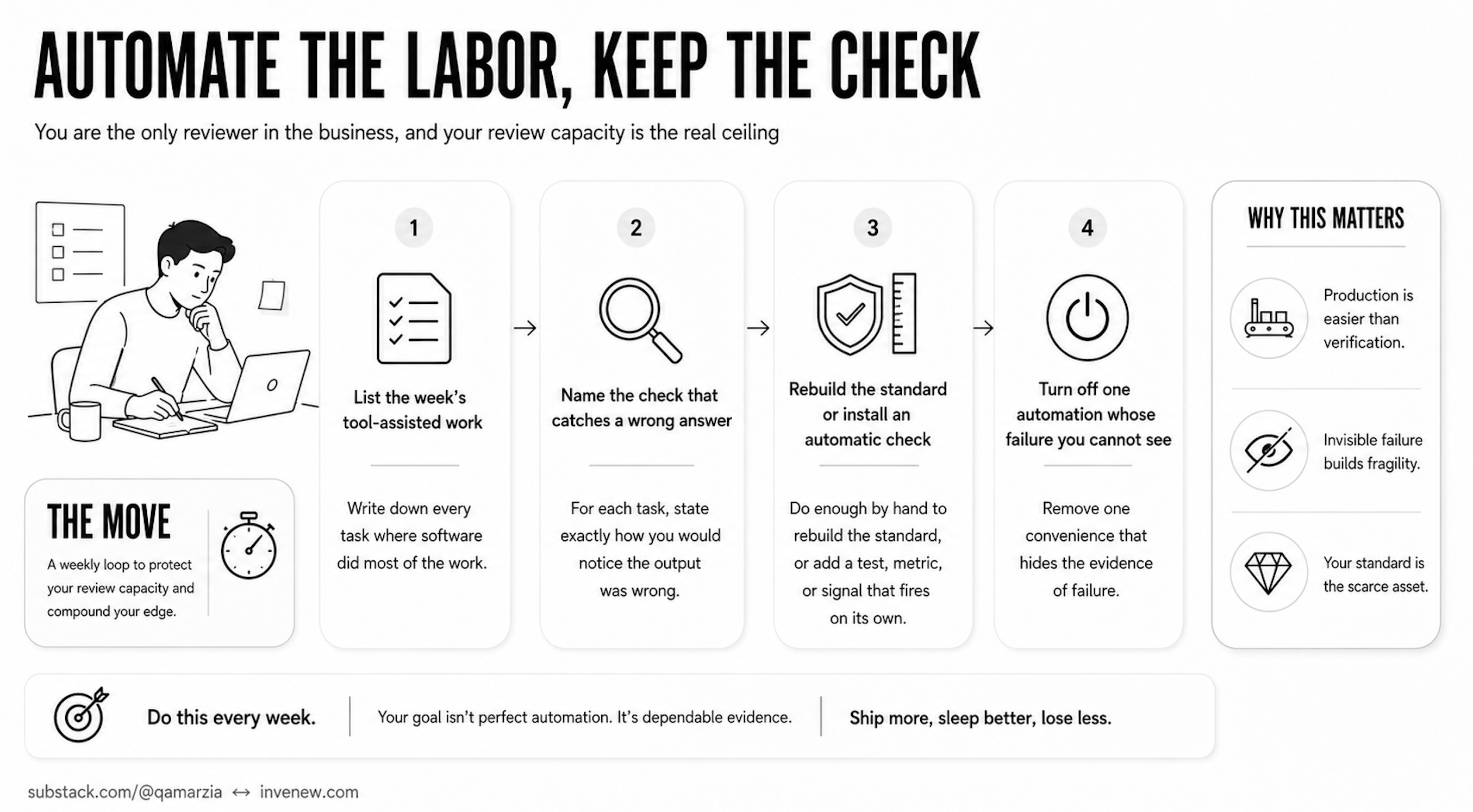
This is an audit, not a policy. You are not deciding whether to use tools. You are deciding which of your checks are real.
Take one week of your own work and write down every task where software did most of it. For each one, ask a single question: if the output were wrong, would I catch it, and how? Name the check. A vague sense that you would probably notice does not count.
Where there is no real check, choose one of two paths. Do enough of the work by hand to rebuild the standard, or install a check that can expose failure without depending on your memory or attention. That could be a test, a number you already watch, a customer reply you would see anyway, a comparison against a known standard, or a simple threshold that forces review.
Then turn off one automation that removed a step whose failure you can no longer see. Fragility is often assembled out of small conveniences. Removing one is a direct way to discover what that convenience was hiding.
Hard to displace
The capacity you rent from a tool is available to everyone who buys the same tool. The standard you use to judge its output is different. That standard was built from work you did, mistakes you made, patterns you noticed, and consequences you absorbed.
It is what lets you use tools you did not build, accept output you did not produce, and still remain answerable for the result. That is the part worth protecting.
Which of your standards are you still strengthening, and which ones stopped developing the moment the work became easy?
If this made you think differently, leave a comment or your reaction. I’d like to hear where you landed.
DRRIVEN is where I write for founders, builders, and independent thinkers on technology, work, and clear thinking. If you want the build-level material on putting AI to work, that lives at INVENEW.
Wow, that gave me a new and great perspective at looking at my own business!