

The Emerging Skill Stack for the AI Economy
The capabilities becoming more valuable as AI makes routine execution cheaper


Every major technology shift creates a rush to learn the new tools. AI has created the largest one I have seen.
People are learning prompting, automation platforms, coding assistants, agent frameworks, model selection, and whatever new application appeared last week. Employers are rewriting job descriptions. Training companies are producing longer lists of skills to master.
Some of this is necessary. Much of it starts with the wrong question.
The question most people ask is: Which AI skill should I learn?
The more useful question is: What combination of capabilities becomes more valuable when AI can perform more of the routine execution?
That combination is the emerging skill stack.
It does not belong only to engineers, data scientists, or people building models. It is forming inside nearly every kind of knowledge work. AI fluency sits at the base, but it is only the beginning. Domain knowledge gives the technology context. Problem framing gives it direction. Workflow design turns it into useful work. Evaluation makes the work trustworthy. Translation helps other people adopt it. Outcome ownership connects the entire stack to value.
The advantage comes from the combination, not from any one skill.
The market is repricing work
Most discussion about AI and employment focuses on jobs. Which jobs will disappear? Which new titles will appear? Which industries will be disrupted first?
Jobs matter, but a job is a bundle of tasks, decisions, relationships, responsibilities, and skills. AI can make one part of that bundle cheaper while making another part more important.
A report writer may spend less time producing a first draft and more time deciding what the report should say. A developer may write less routine code but spend more time reviewing architecture, testing edge cases, and integrating systems. An analyst may produce more analysis but face a harder problem deciding which findings deserve attention. A manager may delegate more work to AI while taking greater responsibility for defining the work, reviewing the result, and managing its consequences.
The job remains. Its internal economics change.
The World Economic Forum says employers expect 39% of workers’ core skills to change by 2030. Analytical thinking remains the most widely valued core skill in its survey, while AI and big data, technological literacy, creative thinking, resilience, leadership, and lifelong learning are all rising in importance. The signal is not that technical capabilities will replace human ones. It is that more work will require both.
PwC’s 2026 Global AI Jobs Barometer offers a more specific view. After analysing more than one billion job advertisements across six continents, PwC describes a two-track labour market. In some roles, AI “democratises” work by making it easier for less-experienced people to perform. In others, AI “professionalises” work by increasing the value of expertise, judgment, creativity, and leadership. PwC reports that professionalised roles are growing twice as fast as democratised roles and have experienced 42% faster wage growth since 2021. The skills requested in the most AI-exposed jobs are also changing more than twice as fast as those in the least-exposed jobs.
These findings need to be read carefully. Job advertisements do not tell us everything that happens after someone is hired. PwC’s categories are analytical classifications, not permanent divisions between good and bad occupations. The data shows relationships, not proof that AI alone caused every difference.
But the direction is useful.
AI is not making every skill equally valuable. It is reducing the cost of some forms of execution while increasing the importance of deciding what should be done, supplying the right context, verifying the result, integrating it into a real workflow, and accepting responsibility for what happens next.
This is why “AI will replace jobs” is too crude, but “AI will only replace tasks” is also incomplete. When enough tasks change, the expectations inside a job change with them. A role may keep its title while demanding a different level of judgment, speed, technical fluency, and accountability.
AI is not merely automating work. It is repricing the capabilities around the work.
The unit of value is becoming the stack
Most future-skills advice arrives as a list.
Learn AI. Think critically. Communicate. Be adaptable. Develop emotional intelligence. Learn to code.
Each recommendation may be reasonable, but a list does not explain how value is created.
Employers and customers rarely buy an isolated skill. They buy a combination of capabilities that solves a problem.
Knowing how to use an AI tool can produce an output. Combining AI fluency with legal knowledge, risk judgment, and careful review can produce a usable legal workflow. Knowing how to automate a process can remove steps. Combining automation with operational knowledge, controls, escalation paths, and monitoring can create a reliable system. Knowing how to analyse data can produce findings. Combining analysis with commercial context and communication can influence a decision.
The emerging advantage is compositional. It comes from how capabilities reinforce one another around a real problem.
AI literacy belongs in that combination, but it is unlikely to remain a durable advantage by itself. A capability becomes less differentiating as it becomes more widely available. Search, email, spreadsheets, presentation software, and cloud applications all created advantages for early adopters before becoming expected parts of work.
AI literacy appears to be following the same path.
That does not mean everyone needs to become an AI engineer. The OECD’s 2026 review of AI and skills concludes that fewer than 1% of workers will need advanced AI-specific capabilities such as programming or model development. Most workers will instead need digital skills, the ability to use and interpret data, and complementary managerial and human capabilities such as problem-solving, creativity, and innovation.
For most people, the opportunity is not to build the underlying intelligence. It is to apply increasingly accessible intelligence to an important problem.
That requires a stack.
The stack taking shape
I see seven capabilities becoming more valuable together.
AI fluency supplies leverage. This is the ability to use AI as a regular working instrument rather than an occasional novelty. It includes selecting a suitable tool, providing useful context and constraints, breaking larger work into manageable parts, judging when the output is weak, protecting sensitive information, and knowing when AI should not control the work. Fluency is deeper than prompting. Prompting is an interface skill. Fluency is the ability to incorporate AI into the way work is actually performed.
Someone can know dozens of prompt techniques and still struggle to create anything useful. Another person may use simple instructions but understand the problem, the context, and the desired outcome so well that the result is far better. The difference is not verbal cleverness. It is operational understanding.
Domain depth supplies context. AI systems can generate plausible answers across many subjects. Plausibility is not the same as usefulness. Domain depth includes knowledge of customers, business processes, economics, regulations, quality standards, organizational constraints, common failure modes, and the unwritten realities that rarely appear in a prompt.
This context lets someone see the gap between an answer that sounds right and one that can survive contact with reality. A model may generate a technically elegant solution that cannot be implemented in the organization. It may recommend an efficient process that violates a regulatory requirement. It may produce a polished analysis based on the wrong assumptions. Domain knowledge helps detect these failures before they become decisions.
Problem framing supplies direction. AI can produce answers before a team has agreed on the question. That makes problem framing more important, not less.
Problem framing means identifying what is actually being solved, who experiences the problem, why it matters, what success looks like, which constraints must be respected, what information is missing, where the consequences of failure sit, and which decisions should remain human.
A weakly framed problem produces faster confusion. A well-framed problem gives intelligence a useful direction. As execution becomes easier, choosing the right work becomes a larger part of the value. The scarce capability is often not answering a question. It is recognizing which question deserves to be answered.
Human-AI workflow orchestration supplies execution. AI rarely creates meaningful value as a standalone chat window. It must be placed inside a workflow.
Someone has to decide what people should do, what models can do, which tools and data sources are needed, how context will move between steps, where review should occur, how exceptions will be handled, when the system should escalate or stop, and how feedback will improve performance.
This is broader than task automation. It requires understanding how work moves through a system and how one decision affects the next. In an AI-assisted incident-management workflow, for example, the value does not come merely from asking a model to summarize logs. It comes from determining which data the model can access, identifying the signals that matter, setting confidence thresholds, preserving human escalation, testing false positives, and connecting the workflow to outcomes such as faster recovery.
The AI performs part of the work. The person with the stack designs the system around it.
Evaluation supplies confidence. When producing an output becomes easier, judging the output becomes more important.
AI can create more code, documents, analyses, recommendations, and decisions than a team previously had the capacity to produce. That abundance creates a selection problem. Which outputs are accurate? Which are reliable enough for the intended use? Which failures matter? When should a person intervene?
Evaluation includes defining acceptance criteria, testing results against realistic cases, comparing performance with a baseline, monitoring behaviour over time, and knowing when to override or stop a system. NIST’s AI Risk Management Framework treats testing, evaluation, verification, validation, human oversight, and ongoing monitoring as capabilities required across the AI lifecycle, not as a final accuracy check added at the end.
This is one reason judgment may appreciate even as output becomes cheaper. Abundance does not remove the need for quality. It increases the need to distinguish quality from confidence, polish, and speed.
Translation supplies adoption. A technically capable system can still create little value if people do not understand it, trust it, approve it, or change how they work.
Translation connects technical capability to business need, model performance to user value, risk concerns to workable controls, data findings to decisions, and a new workflow to the people expected to use it. It includes communication, teaching, stakeholder management, and change leadership, but it is more specific than being a good communicator.
The valuable skill is translating one form of knowledge into another without losing what matters. It is helping technical teams understand the business problem, helping leaders understand the trade-offs, and helping users understand how their work will change.
AI adoption is often presented as a technology problem. In practice, the missing piece is frequently the bridge between the technology and the organization around it.
Outcome ownership supplies value. The top of the stack is responsibility for the result.
Outcome ownership means moving beyond task completion. It requires defining what success means, selecting meaningful measures, making trade-offs, managing consequences, correcting failures, improving the workflow, and demonstrating that the result is worth its cost.
An AI-assisted task may be complete when a model produces an answer. A real problem is complete only when the answer has been tested, acted upon, and shown to create value.
AI may perform more of the work, but someone still has to decide whether the work is accurate enough, useful enough, safe enough, and ready to use. Someone must carry authority and accountability.
Many people will be able to generate more work. Fewer will be prepared to own what happens next.
These seven capabilities form one system. AI fluency supplies leverage. Domain depth supplies context. Problem framing supplies direction. Workflow orchestration supplies execution. Evaluation supplies confidence. Translation supplies adoption. Outcome ownership supplies value.
Remove one and the stack weakens. Leverage without context produces generic work. Context without orchestration remains trapped inside one person’s head. Orchestration without evaluation creates risk at scale. Evaluation without translation creates systems people do not use. Adoption without ownership produces activity without measurable value.
The capabilities compound.
Experience is raw material
I spent over two decades leading cloud infrastructure and operations while staying close to engineering, technical architecture, DevOps, and DataOps.
Every technology shift produced a new list of skills to learn. The lasting advantage rarely came from learning the new tool alone. It came from combining the tool with an understanding of systems, customers, failure, cost, risk, people, and operational reality.
AI makes this distinction even more important.
Experience can be a valuable input, but it is not automatically a moat. Someone can spend 20 years repeating a process that technology is about to change. Time served does not guarantee useful judgment. Familiarity can even become a liability when it hardens into attachment to the old way of working.
Experience becomes valuable when it has produced pattern recognition, knowledge of failure modes, realistic constraints, faster trade-offs, stronger quality standards, better escalation decisions, and reusable operating principles. It then has to be translated into a new environment.
The experienced professional who only defends the old workflow may become exposed. The one who can identify what should remain, what can be delegated, what must be redesigned, and where human judgment still matters may become more valuable.
Experience is not the finished advantage. It is raw material for the stack.
This creates a harder problem for people entering the workforce.
Routine work has historically served two purposes. It produced an output for the employer, and it helped the worker develop judgment through repetition. Junior employees prepared first drafts, checked spreadsheets, reviewed logs, researched customers, and completed initial analyses. Much of the work was basic, but performing it repeatedly helped them recognize patterns and develop professional standards.
AI can now perform or accelerate many of those tasks.
That does not mean entry-level work is simply disappearing. A 2026 Strada survey of nearly 1,500 U.S. executives and senior talent leaders found that employers were 2.7 times more likely to expect AI to increase entry-level hiring than decrease it. At the same time, employers reported that AI was reducing some foundational skill-building tasks while increasing analytical and judgment-based responsibilities.
PwC found a similar change in expectations. The most AI-exposed junior roles were seven times more likely than the least-exposed junior roles to request traditionally senior capabilities such as leadership and strategic thinking. PwC also found that these “seniorised” entry-level roles had grown 35% since 2019 while other entry-level roles declined.
The first rung is not simply vanishing. It is moving upward.
New workers may be expected to use judgment earlier while losing some of the repetitive work through which judgment was previously developed. Organizations will need new forms of apprenticeship. Individuals will need new ways to practise, build evidence, and demonstrate capability before they are given formal authority.
This is not a side issue. It is one of the central tensions in the emerging skill stack. The market may ask for judgment sooner while providing fewer traditional opportunities to develop it.
Build the stack around real work
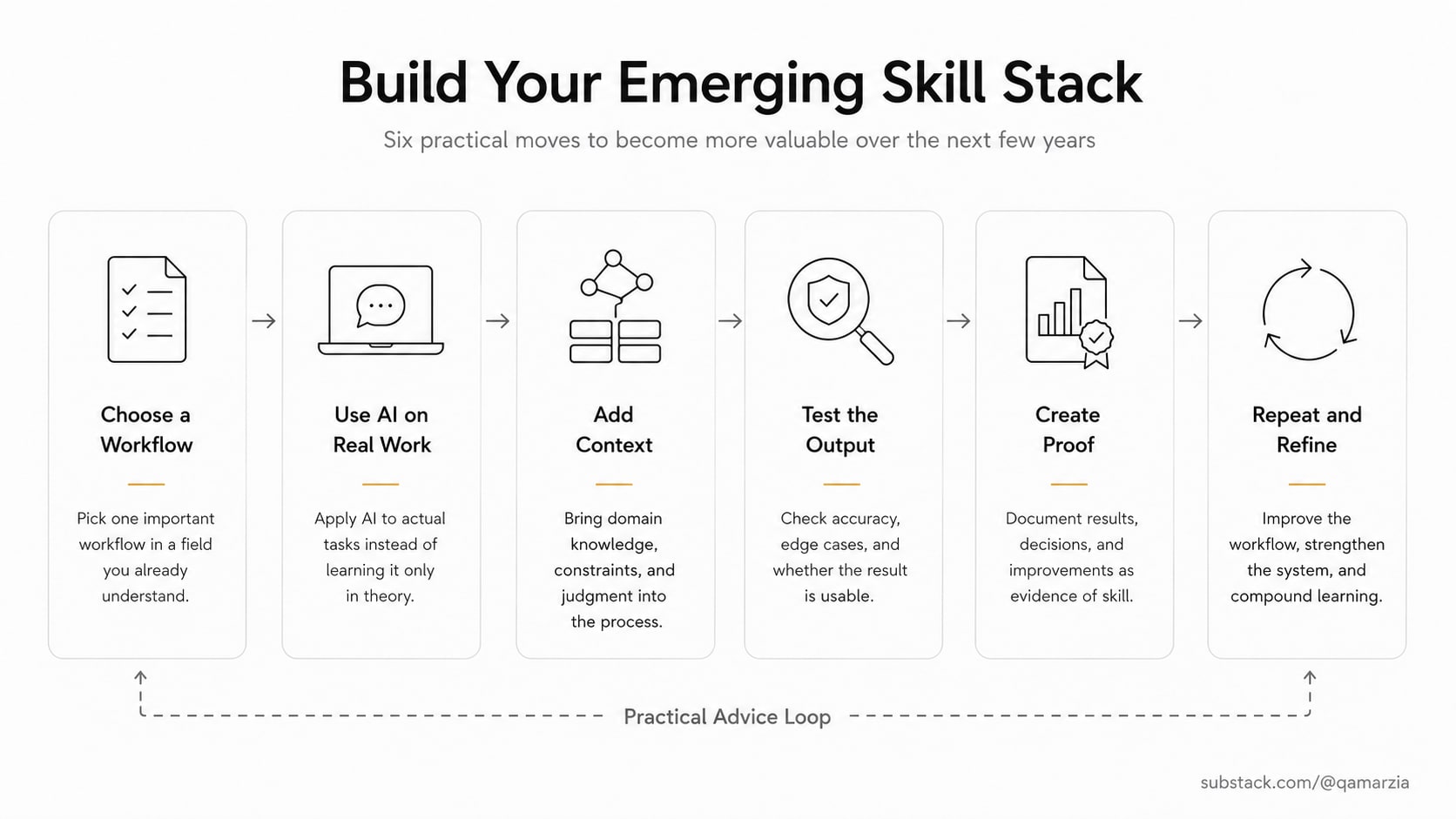
The response is not to collect more disconnected skills.
Start with one important workflow in a field you understand and ask seven questions.
Use: Can I use AI effectively within this workflow?
Understand: Do I know the domain well enough to recognize a weak or misleading result?
Frame: Can I define the actual problem, constraints, and desired outcome?
Design: Can I decide what people, models, software, and data should each contribute?
Verify: Can I test whether the output or system is reliable enough for its intended use?
Translate: Can I explain and introduce the workflow to the people who must approve, operate, or rely on it?
Own: Can I accept responsibility for the result and demonstrate that it creates value?
The weakest answer reveals the next capability to build.
Do not begin with a long course catalogue. Begin with real work. Use AI inside the workflow. Improve it. Measure the difference. Document the decisions. Record the failures. Create an artifact that shows how you think.
The market cannot see a skill hidden inside your head. It can see what you have built, improved, explained, or proven.
This is also why credentials may become less sufficient in fast-moving areas. A certificate can show that someone completed a course. It cannot, by itself, show that the person can frame an ambiguous problem, design a reliable workflow, make sound trade-offs, or own an outcome. Evidence will increasingly need to include work samples, operating artifacts, case studies, prototypes, decision records, and measurable improvements.
The aim is not to become good at AI in the abstract. It is to become better at solving a particular class of problems because AI is now part of your stack.
Hard to displace is a position
There are no permanently future-proof skills.
AI capabilities will improve. Tools will become easier to use. Some forms of judgment will be encoded into systems. Workflows that require careful orchestration today may become standard products tomorrow. Capabilities that are scarce now may become ordinary.
The stack must keep evolving.
The durable position is not possession of a fixed list of skills. It is staying close to valuable problems, understanding how the work is changing, and rebuilding your combination of capabilities as the market changes around you.
Hard to displace is not a personality trait or a promise of safety. It is a position in a market, and positions must be maintained.
The emerging advantage will not automatically belong to the person with the most experience, the strongest technical credentials, or the greatest number of AI tools. It will belong to the person who can connect increasingly accessible intelligence to an important problem, apply real context, design the work, verify the result, bring others along, and remain responsible for what happens next.
That is the emerging skill stack for the next few years.
The Emerging Skill Stack series
This essay introduces the framework. Over the coming weeks, I will research the forces forming around it in a multi-part deep dive:
1. When Execution Gets Cheap → How AI shifts value from producing more work toward selecting problems, applying judgment, integrating systems, and carrying accountability.
2. The First Rung Is Moving → What happens when AI absorbs some of the foundational work through which people traditionally learned their professions.
3. The Stack Above AI Literacy → Why knowing how to use AI is becoming necessary, and why it will not be enough to create a durable advantage.
4. Your Experience Is Raw Material → How domain knowledge becomes valuable when it is translated into better decisions, workflows, standards, and outcomes.
5. Proof Before Permission → How to demonstrate emerging capabilities when established degrees, titles, and certifications have not caught up.
6. Where the Emerging Stack Gets Paid → Where employers and customers are buying combinations of domain translation, workflow redesign, evaluation, orchestration, and governance.
7. Hard to Displace Is a Position → Why durability comes from maintaining a valuable place in a changing market rather than protecting a fixed professional identity.
The essays will move from understanding the market to building, proving, and earning from the stack.
The central idea will remain the same: as intelligence becomes easier to access, value moves toward the people who know what to do with it.
DRRIVEN is where I write for founders, builders, and independent thinkers on technology, work, and clear thinking. If you want the build-level material on putting AI to work, that lives at INVENEW.